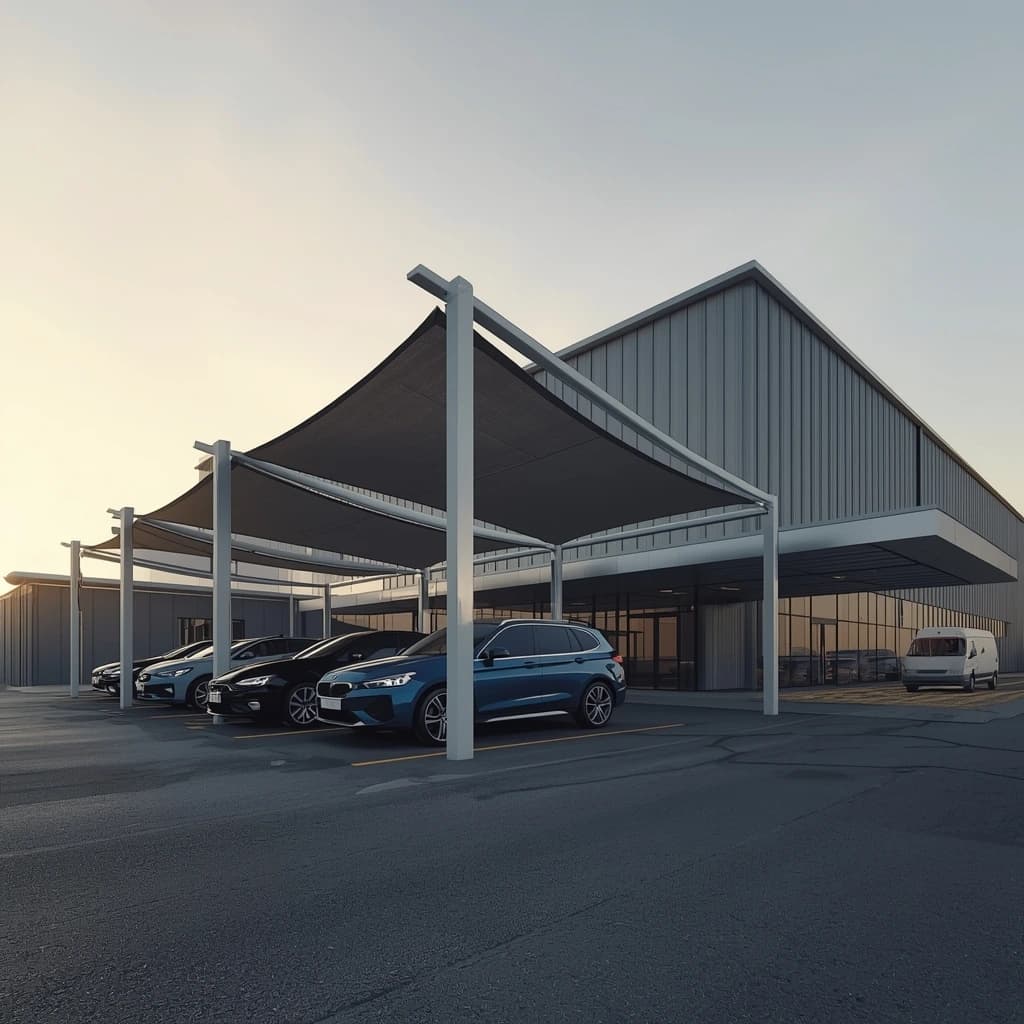
Quick answer: do you need a permit?
It depends on which emirate you are in and, more importantly, whose ground the shade stands on. A shade over a bay on public or community land is regulated everywhere; a shade entirely inside your own plot boundary is usually a matter for the municipality's building rules and your community's design guidelines rather than a parking-shade permit.
| Emirate | Reserved residential bay outside your plot | Inside your own villa plot | Commercial or building car park |
|---|---|---|---|
| Dubai | RTA Parking Shade Installation Permit, via an approved contractor | Dubai Municipality building rules + developer / owners' association NOC | Dubai Municipality approval as part of the building works |
| Abu Dhabi | Municipality permit — AED 1,000, plus AED 200 a year | Municipality building rules + community NOC | Municipality approval as part of the building works |
| Ras Al Khaimah | ZP22 Parking Shade Permit — around AED 800 plus deposit | ZP22 applies to plot frontage shades | Municipality approval |
| Sharjah, Ajman, Fujairah, UAQ | Each municipality applies its own requirements | Municipality building rules + community NOC | Municipality approval |
Dubai: the RTA Parking Shade Installation Permit
The RTA introduced the permit in January 2026 in response to residents installing shades over neighbourhood parking without any approval. It covers designated residential parking spaces that have been formally reserved — by a developer, an owners' association or the relevant authority — for a particular resident. It does not cover public parking bays or roadside spaces, and it does not turn an unreserved bay into a reserved one.
How the application works
Residents do not apply directly. The permit is processed through RTA-approved contracting companies, which submit the application through the RTA's unified digital portal and coordinate the site assessment, the design validation and the checks with service entities — the utilities and telecoms providers whose lines may run under or beside the bay. The RTA has also referred to applications through its website and the Dubai Drive app. As of the time of writing, no permit fee has been publicly confirmed and no fixed processing time has been announced; the applicant bears the cost of installation, maintenance and any future removal.
What the shade must look like
- Follow an RTA-approved design typology — the authority has set standard forms rather than approving one-off designs.
- Canopy cover in desert colours; structure in mild steel or aluminium, or powder-coated in light beige. Highly reflective, visually intrusive or inconsistent colours are not accepted.
- Foundation depth must not exceed 0.7 metres.
- Height sufficient for standard SUVs and service vehicles, with clearance left for pedestrians.
- Built from high-quality, weather-resistant materials.
What the shade must not do
- Obstruct pedestrian movement or the continuity of soft-mobility paths.
- Compromise traffic flow or driver visibility.
- Block traffic signs or road markings.
- Interfere with utility lines, telecommunications infrastructure or trees.
Every permitted shade is temporary by definition. The owner must remove it on request from any service authority for development projects, maintenance works or emergencies. The RTA has said it runs regular inspection tours for unauthorised structures; an owner found with one receives a notice to rectify, failing which the structure is removed at the owner's expense.
Dubai: private villa plots and owners' association NOCs
A shade that stands entirely inside your own plot — a driveway shade on a freehold villa, for example — is not what the RTA permit is for. It falls under Dubai Municipality's building regulations, and in practice under whatever design guidelines your master developer or owners' association enforces. Most established communities have rules on what can be built in the front setback, on heights, on colours and on whether a structure is visible from the street, and they issue a no-objection certificate before work starts.
In our experience the community NOC, not the municipality, is the part of the programme that takes longest, and the part most likely to send a design back for changes. Ask for the community's external-works guidelines before you choose a structure, not after — a design that clears them on the first submission is worth more than a cheaper one that does not. We prepare the drawings Dubai Municipality and owners' associations ask for as part of the job.
Abu Dhabi: the Municipality car park shade permit
Abu Dhabi City Municipality published its rules on 8 September 2026 for shades installed outside the boundary of a residential plot, in private residential and public housing areas. The service is titled Issuing a Permit to Install Car Park Shades Outside the Boundary of a Residential Plot and is applied for on the TAMM platform, under Housing and Construction, using a UAE Pass digital identity. The application needs a site plan and the supporting documents listed on the service page.
The permit costs AED 1,000, with an annual renewal fee of AED 200. Owners who already hold a Regulation of Works Outside the Boundary permit are exempt from the separate shade permit.
Abu Dhabi's design limits
- A single shade must not exceed 3 metres by 6 metres — one car.
- The lowest point must be at least 2.5 metres above the pavement; the highest point must not exceed 4.5 metres.
- Light, pale colours that match the frontage of the villa or house.
- Zinc sheeting, worn fabric and untreated wood are prohibited.
- The shade must not obstruct pedestrian or vehicle movement or block visibility, and must leave clear access for civil defence and to underground services.
- It may not be rented out or used for anything other than residents' parking.
As in Dubai, the structure is conditional: the owner must remove it immediately and at their own expense if the Municipality asks.
Ras Al Khaimah, Sharjah, Ajman and the other emirates
Ras Al Khaimah has the most detailed published scheme. The ZP22 Parking Shade Permit from RAK Municipality is open to individual plot owners or their consultants, quotes a processing time of 21 working days, and costs AED 100 for submission, AED 100 for the surveyor's visit and AED 100 per parking bay, plus a refundable deposit of AED 500. The conditions are specific: one shade per plot; total area no more than three standard parking spaces; length no more than half the plot's road-facing frontage; at least 6 metres from a chamfered plot corner; nothing on vacant plots or beside public facilities. Covers must be UV-resistant and fire-retardant — HDPE, PVC, PVDF and PTFE are all acceptable, aluminium and asbestos are not — and the structure and materials must carry a warranty of at least 10 years.
Sharjah, Ajman, Fujairah and Umm Al Quwain each apply their own municipal requirements to external works, and there is no single published parking-shade scheme equivalent to Dubai's or Abu Dhabi's at the time of writing. The practical route is the same in each: the municipality's building-permit process for works at the plot boundary, plus whatever the community requires. On our Ajman projects we deal with the Municipality documentation directly.
Documents you will need
Exact lists vary by authority, but between them the published schemes ask for the following. Having them ready before the contractor is appointed is the single biggest thing you can do to shorten the programme.
- Site plan, with the title deed or affection plan where you have it.
- Proof that the bay is reserved to you — the developer's or owners' association's allocation.
- Drawings showing the proposed design, dimensions, colour and materials of the shade.
- A location plan showing where on the plot or bay it will stand.
- The contractor's valid trade licence.
- A letter of authorisation if a consultant or contractor is applying on your behalf.
- Any previous building permit for the plot, where the authority asks for it.
- Your Emirates ID or UAE Pass identity for the online submission.
Common reasons applications are rejected
- The bay is not actually reserved. A space you have always used is not the same as one formally allocated to you. Dubai's permit only applies to the latter.
- Wrong colour. Dubai wants desert tones and light beige structures; Abu Dhabi wants pale colours matching the house. A dark green or navy canopy is the fastest way to a rejection.
- Too big or too tall. Abu Dhabi's 3 × 6 metre and 4.5 metre limits, and RAK's three-bay and half-frontage limits, are hard ceilings.
- Foundations too deep or over services. Dubai caps foundation depth at 0.7 metres precisely because of what runs underneath a pavement.
- Blocking something. A footpath, a sight line at a junction, a sign, a tree, a civil-defence access route.
- Non-compliant materials. Zinc sheet, untreated timber, reused fabric — all explicitly excluded.
- Missing the community NOC. The authority may approve while the owners' association has not, or the other way round. Both are needed.
Installing without a permit
In Dubai the RTA has said it inspects for unauthorised structures; the owner gets a notice to bring the shade into compliance or remove it, and if that is ignored the structure is taken down at the owner's expense. Abu Dhabi's rules carry the same immediate-removal condition. The practical risk is not a fine so much as paying twice — once to install a shade that does not meet the standard, and again to take it down.
How we handle the permit side
The permit is easier when the shade is designed to pass in the first place. We prepare the drawings and documentation the authorities and owners' associations ask for, size and colour the structure to the published limits from the start, and specify foundations that stay within the depth allowed. Our standard single bay is 6.0 m × 3.0 m, which sits exactly on Abu Dhabi's limit, and our written warranty of 5 to 15 years on structure and roofing covers the 10-year minimum RAK requires when the right materials are chosen. Fabrication is at our Sharjah facility and installation is by our own crews. If you want the full picture on types, materials and costs before you apply, start with the complete guide to car parking shades in the UAE, or send us photographs and the community guidelines through the contact page.