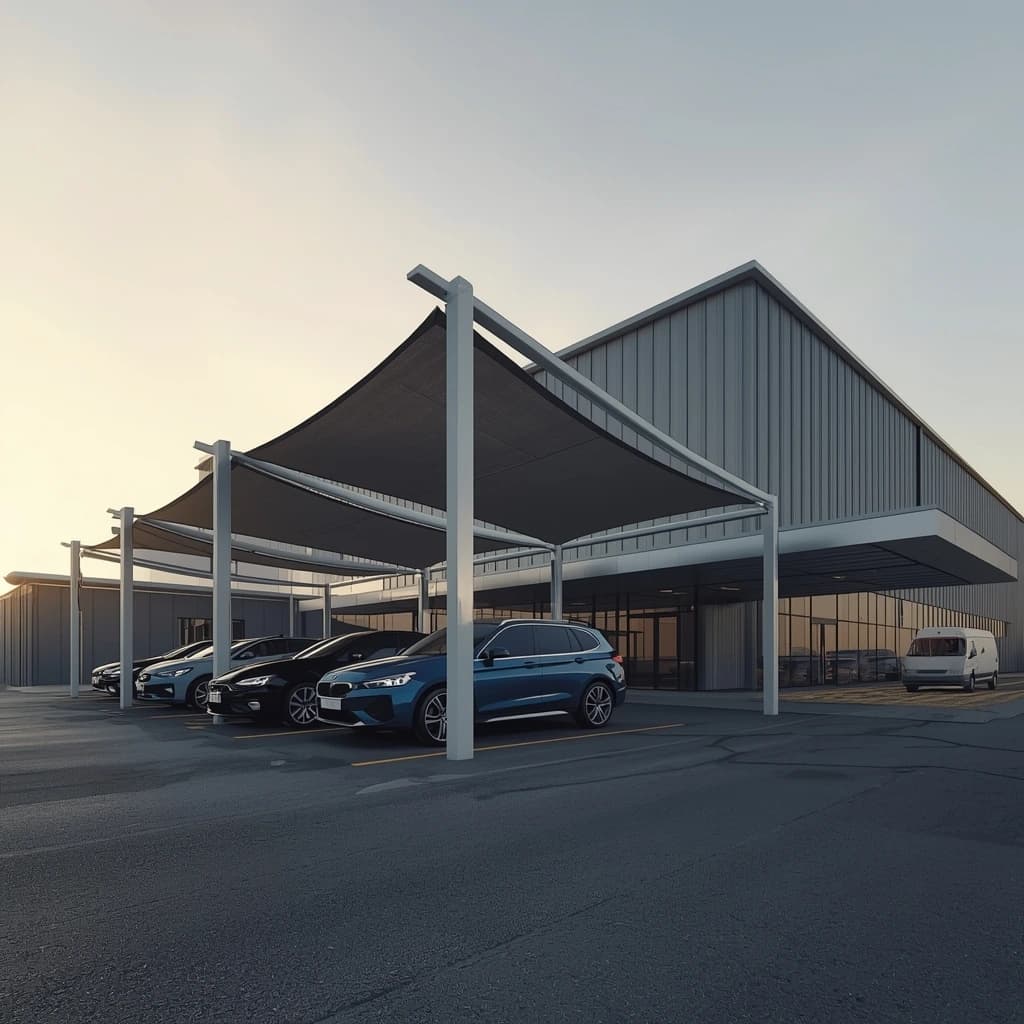
Why a car parking shade is not a luxury in the UAE
Summer air temperatures across the Emirates regularly sit in the high forties, and a closed vehicle left in direct sun climbs far past that. Surfaces a driver actually touches — the steering wheel, the gear selector, a leather seat — get hotter still. Shade does not make the air cooler, but it removes the direct solar gain that drives the cabin temperature up in the first place, which is why a shaded car is noticeably more bearable to get into after a day parked outside.
The damage is cumulative rather than dramatic. Ultraviolet radiation breaks down clear coat and fades paint. Dashboards and trim plastics become brittle and crack. Leather dries and splits. Rubber seals perish early. None of it happens in one summer, but a vehicle kept in the open through several UAE summers ages visibly faster than the same car kept under cover, and that difference shows up again at resale.
Sun is not the only problem. Shamal winds carry fine sand that settles into panel gaps and scours paintwork, and the winter rains — infrequent, but heavy when they arrive — leave mineral spotting on glass and bodywork. A roof over the bay deals with all three. Our fabrics use high-density polyethylene knitted cloth that blocks up to 98% of UV while staying breathable, or PVDF-coated PVC membrane where full rain cover matters more than airflow.
The 13 types of car parking shade, and how to choose
Every structure we build falls into one of five families. The choice is driven by how many bays you are covering, where the columns can physically go, whether you need the roof to be waterproof, and how much the structure has to match the building behind it.
Cantilever structures
Cantilevers carry the roof from one side only, so nothing stands between the parked cars. Top-support shades hang the fabric from an arm above, which is the most common choice for a villa driveway. Bottom-support shades brace from ground level for extra stability and repeat cleanly along a row. Truss cantilever shades use a trussed arm to reach further, and are what we specify for back-to-back rows in commercial car parks, where a central column would block one side entirely.
Tensile and membrane structures
These tension a fabric membrane into a shape that sheds wind and water by geometry rather than mass. Pyramid shades use a four-sided peak that distributes stress evenly and drains well. Conical shades do the same with a single cone and suit stand-alone bays. Umbrella shades are independent single-post units that can be repositioned or reconfigured later. Tensile roof shades span a wider area per column than a solid roof, which keeps large open lots free of obstructions. CNC pattern shades add a laser-cut perforated panel where the structure needs to be an architectural feature.
Rigid-roof structures
K-Span roofs use a self-supporting curved steel profile that covers wide spans with strong wind and load resistance and needs minimal upkeep. GRP roofs use high-strength fibreglass panels that are tear resistant, dimensionally stable and comfortable to sit under. Corrugated sheet roofs are the practical, cost-effective option where appearance matters less than robust cover.
Solar and bespoke
Solar panel shades carry PV modules as the roof itself — a single 6.0m × 3.0m bay accommodates a 6–9 panel array, a double bay 12–18 — with module weight and wind-load calculations built into the structural design. Customised designs are built to a specific brief where none of the standard families fit the site or the architecture.
| Family | Best for | Roof is waterproof | Relative cost |
|---|---|---|---|
| Cantilever | Villa driveways, rows with no room for centre columns | Depends on fabric | Low to medium |
| Tensile / membrane | Open lots, wide spans, architectural sites | Depends on fabric | Medium |
| Rigid roof | Long service life, full rain cover, large spans | Yes | Medium to high |
| Solar | Sites that also want generation and EV readiness | Yes | High |
| Customised | Anything the standard families cannot match | Specified per project | Varies |
Each type is described in more depth — how it is built, what it suits, sizes and relative cost — in our guide to the 13 types of car parking shade, and the full range with photographs and specifications is on the car parking shades section of the site.
Roofing materials: HDPE, PVC, PTFE, GRP and metal
Material choice decides three things that matter more than anything else on the quote: how hot it gets under the roof, whether rain comes through, and how many years you get before the roof needs replacing.
HDPE knitted cloth is a woven high-density polyethylene mesh. It blocks up to 98% of UV while letting hot air escape upward through the weave, so it does not trap a layer of heat against the roof the way a sealed membrane can. It is the most economical option and the usual answer for a villa driveway. It is not waterproof — rain passes through — and it is stitched rather than welded, so the seams are the part to inspect as it ages.
PVDF-coated PVC membrane is a coated polyester fabric. We specify it at 850 GSM, fire-retardant, UV-resistant and fully waterproof. Its seams are welded rather than sewn, which makes them stronger than stitched joints, and the PVDF top coat keeps it cleanable and slows discolouration. It is the right choice for podium parking, commercial sites and any bay where rain cover is the point. Because it is a sealed surface it absorbs more heat than breathable mesh, so the roof height and the airflow around the bay matter more with PVC than with HDPE.
PTFE is the long-life architectural membrane, used where a structure is expected to stand for decades and the budget supports it. GRP panels and corrugated metal give a rigid, fully waterproof roof; K-Span goes further by making the roof profile the structure. Rigid roofs last longest and need least attention, at a higher price per square metre and with more radiant heat underneath than a breathable mesh.
| Material | Waterproof | Heat underneath | Typical service life |
|---|---|---|---|
| HDPE knitted cloth | No — breathable mesh | Lowest, air escapes upward | Around 8–10 years |
| PVDF-coated PVC (850 GSM) | Yes, welded seams | Higher — sealed surface | Around 10–15 years |
| PTFE membrane | Yes | Higher — sealed surface | 20 years and beyond |
| GRP panel | Yes | Moderate, diffuses light | 15 years and beyond |
| K-Span / corrugated steel | Yes | Highest without ventilation | 20–25 years |
Whatever the roof, the frame underneath is hot-dip galvanised steel as standard, with marine-grade fixings on coastal sites where salt air attacks ordinary steel. Fabrics are available in white, cream, green, dark green, grey, dark grey, orange, yellow, black, red, blue and dark blue. Lighter colours reflect more and show dust less; darker colours hold their appearance longer against fading but absorb more heat.
Sizes, bays and layouts
Our standard single bay is 6.0m × 3.0m, which covers one car comfortably including the door swing. Two cars side by side take a 6.0m × 6.0m bay. Beyond that, structures repeat along a row using the same module, and custom sizes are made to the site.
Height is the dimension most often got wrong. A shade sized for a saloon will not clear a large SUV with a roof box, a pickup, or a van — and in a compound with mixed vehicles the clearance has to suit the tallest one that will ever park there, not the car in the driveway today. Column positions matter just as much: a post in the wrong place turns an easy reversing manoeuvre into a daily irritation, which is the main reason cantilever designs are so common on villa plots.
For larger car parks the layout question is whether columns can sit between rows at all. Where they cannot, a truss cantilever covering back-to-back bays from one side, or a column-free K-Span roof, keeps the whole parking area clear. We work this out on the site survey and send drawings before anything is fabricated; the sizes and dimensions guide has the standard footprints, clear heights by vehicle and how to measure your site.
What decides the price of a car parking shade
Pricing is quoted per square metre for larger jobs and per bay for small residential ones, and the only figure that means anything is the one written against your actual site after a survey. Two shades that look similar in a photograph can differ by a wide margin once the steel section, the fabric grade, the foundations and the access are taken into account — which is why we do not publish a rate card.
Seven things move the figure:
- Structure type — a simple top-support cantilever and a CNC-pattern architectural canopy are not comparable products.
- Roofing material — HDPE mesh, PVDF-coated PVC, GRP and K-Span sit at different price points and different service lives.
- Span and height — longer reaches and taller clearances need heavier steel sections and larger foundations.
- Quantity — per-square-metre rates fall as bay counts rise, because mobilisation and setup are spread across more work.
- Foundations — a villa plot takes conventional footings; a podium or basement roof slab needs anchoring that does not compromise the waterproofing below.
- Site access — restricted access, occupied car parks and phased works all add time.
- Finish — colour, powder-coat specification and any perforated or patterned panels.
Ask for the price broken down rather than as a single figure. A quotation worth comparing states the steel sections and their treatment, the fabric type and its GSM, what the foundations involve, whether drawings and permit handling are included, and the warranty term for each component. Send us photographs and rough dimensions through the contact page and we will survey the site and quote against it.
Permits: what Dubai, Abu Dhabi and the Northern Emirates require
Whether you need a permit depends on who owns the ground the shade stands on.
Dubai. In January 2026 the Roads and Transport Authority introduced a permit covering shades installed over reserved residential parking spaces, applied for through the RTA's unified digital portal. Applications go through approved contracting firms, which handle the submission and coordinate with the relevant service authorities. The published requirements are that the shade must not obstruct pedestrian movement or traffic signs, must not interfere with utility lines, must follow the design and colour standards the RTA approves, and must be removable at the request of a service authority for development, maintenance or emergency works.
Private villa plots and communities. A shade entirely inside your own plot is a different case from one over a public bay, but most master communities and owner associations in Dubai operate their own design rules and require an NOC before work starts. That approval is usually the longer pole in the tent, not the municipality.
Abu Dhabi and the Northern Emirates. Abu Dhabi Municipality operates a car park shade permit with a published fee of AED 1,000. Ras Al Khaimah runs a parking shade permit through its Sanad services portal. Sharjah, Ajman, Fujairah and Umm Al Quwain each apply their own municipal requirements.
Permit rules in this area changed recently and continue to be updated — our parking shade permit guide sets out the current rules, fees, size limits and documents for each emirate — so confirm the current requirement with the relevant authority before committing to a design. We prepare the drawings Dubai Municipality and owner associations ask for and handle the documentation as part of the job — on our Ajman projects, for example, we deal with the municipality paperwork directly so the programme does not stall.
Installation: survey to handover
A standard residential car parking shade takes three to five working days on site from design approval. A three-bay top-support shade we built for a villa compound in Jumeirah — PVDF-coated PVC in cream on a hot-dip galvanised frame — was completed in four working days including the foundation works.
- Site survey. Measurements, vehicle sizes, ground conditions, access, and where columns can and cannot go.
- Design and drawings. Structural layout and fabric shape, with the calculations behind them, issued for your approval and for any authority or association submission.
- Approvals. Municipality, RTA or owner-association documentation, handled by us.
- Fabrication. Steel cut, welded and hot-dip galvanised at our Sharjah facility, and the roofing cut and welded or stitched to the approved shape.
- Foundations. Footings on villa plots; anchored fixings on podium and slab locations.
- Erection and roofing. Frame raised and set, then the roof fitted and tensioned.
- Handover. Final tensioning check, site cleared, and the written warranty issued.
Installation is carried out by our own crews rather than subcontracted, which is the part that decides whether the structure you take delivery of matches the one that was engineered. On occupied commercial sites the work is phased so the car park keeps operating — we installed cantilever shades across a government compound in Al Barsha in stages for exactly that reason.
Wind, engineering and safety
A car parking shade is a large, light roof held above the ground, which makes wind — not weight — the governing load. Shamal winds arrive fast and pull upward on the roof surface, so the structure has to resist uplift as much as downward pressure. Every structure is designed with the structural and fabric calculations behind it and engineered to meet the wind-load and safety requirements the UAE authorities apply.
Three things separate a structure that survives a bad season from one that does not: foundations sized for uplift rather than just for the weight above them, hot-dip galvanising rather than paint on the steel, and fabric kept properly tensioned. Loose fabric flaps, and flapping fabric destroys its own seams and works the fixings loose. Shape matters too — a pyramid or conical roof sheds wind better than a large flat plane of the same area.
Maintenance, lifespan and warranty
Maintenance is light but not optional. Rinse the fabric periodically with mild soap and water to clear dust and sand — harsh chemicals and high-pressure jets damage the coating and the stitching. Check the roof after any serious sandstorm. Before each summer, look over the seams, the fixings and the base plates, and have the tension checked if the fabric has started to slacken.
Service life depends on the material: roughly 8–10 years for HDPE, 10–15 for PVC, longer again for PTFE, GRP and K-Span. Every completed installation carries a written warranty of 5 to 15 years covering both the structure and the roofing, with the exact term set by the materials chosen — the document you receive at handover states the term for each component, what it covers and how to claim. The 32-bay K-Span car park we built on Palm Jumeirah, engineered for Dubai Municipality compliance, carries a 10-year structural warranty.
When a roof reaches the end of its life, the steel underneath is often still sound. If it passes inspection, re-skinning the existing structure costs considerably less than replacing the whole thing. We run inspections, repairs and annual maintenance contracts through our shade maintenance service across the Emirates.
Commercial, industrial and institutional car parks
At scale the priorities change. Bay counts drive the per-square-metre rate down, column-free spans become more valuable than architectural detail, fire-retardant fabric specifications come into play, and the work usually has to be phased around a car park that cannot close.
Retail and mall parking needs consistent bay modules over large areas. Schools need the pick-up lane covered as much as the staff bays. Mosques size for Friday peaks rather than daily use. Labour accommodation and industrial sites need bus bays and hard-wearing structures more than finish. We cover those sites through our industrial shade structures work in Dubai, Jebel Ali and Abu Dhabi, including JAFZA and the industrial zones. Our RTA bus-stop shade work in Al Quoz runs on the same public-infrastructure standards. The commercial parking shades guide covers structures for rows and large lots, sector requirements, phasing and approvals.
Solar carports
A solar panel car parking shade makes the roof generate as well as shade. A single 6.0m × 3.0m bay carries a 6–9 panel array and a double bay 12–18, compatible with monocrystalline, polycrystalline and bifacial modules. Structurally it is a heavier job than a fabric shade: module weight and wind loads go into the design, the frame is hot-dip galvanised steel as standard or marine-grade aluminium on coastal sites, and cable routing has to be planned in.
Solar makes most sense where the site uses the power it generates — a commercial car park beside a building with a daytime load, or a site adding EV charging. For a villa with two bays, a conventional shade usually does the job for much less.
Where we build
Fabrication is at our Sharjah facility and installation is by our own crews across the Emirates. We work throughout Dubai, Abu Dhabi, Sharjah, Ajman, Ras Al Khaimah, Fujairah, Umm Al Quwain, Al Ain, Jebel Ali and Ruwais.